Events

Views Navigation

Event Views Navigation

Today

    Bioethics and the Ethics of AI

    What ethical frameworks for the quick evolution of artificial intelligence and biotechnology? Welcome to USP en conversation - SPU Talks! Join us for an engaging event where we bring together experts to discuss a wide range of topics. From ethics to art, from reconciliation to artificial intelligence, there is something for everyone. Prepare to listen, […]

    Learn More

    AMLD EPFL 2024

    Lesley Wilton presented at Applied Machine Learning Days (AMLD) 2024 sponsored by École Polytechnique Fédérale de Lausanne (EPFL). Her presentation, AI Literacy in the Education Field, can be viewed here. Lesley and also participated in a panel discussion titled Data and AI Literacy – Quo Vadis, which can be heard here.

    Learn More

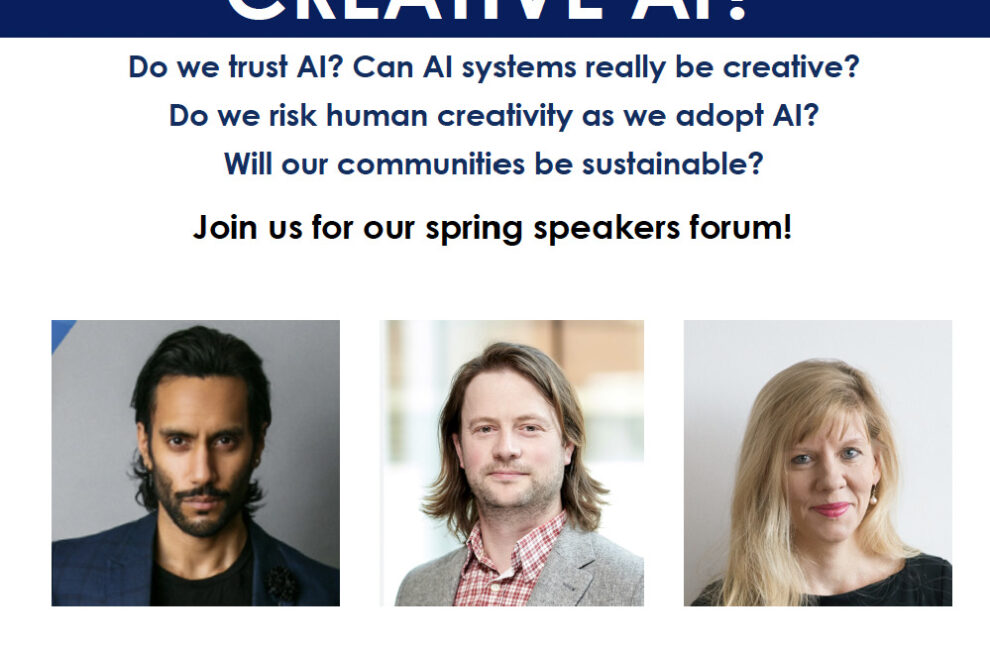
    Ontario Tech University: Creative AI?

    Join us for our spring speakers forum hosted by Digital Life Institute and Trustworthy AI Lab! Historically, creativity has been judged according to its impact and ways that people moved other people’s thinking, challenged longstanding beliefs, or transformed a field. Artificial Intelligence has raised sensationalized debates concerning not only the question over its ability to […]

    Learn More

    Al, Education and Changing Cultural Values

    Join the Artificial Intelligence Initiative on March 6th from 12:00-1:30 pm on Zoom for this semester's first speaker series event. Dr. Isabel Pedersen of the University of Ontario and the Director of the Digital Life Institute will discuss Al, education and changing cultural values.

    Learn More

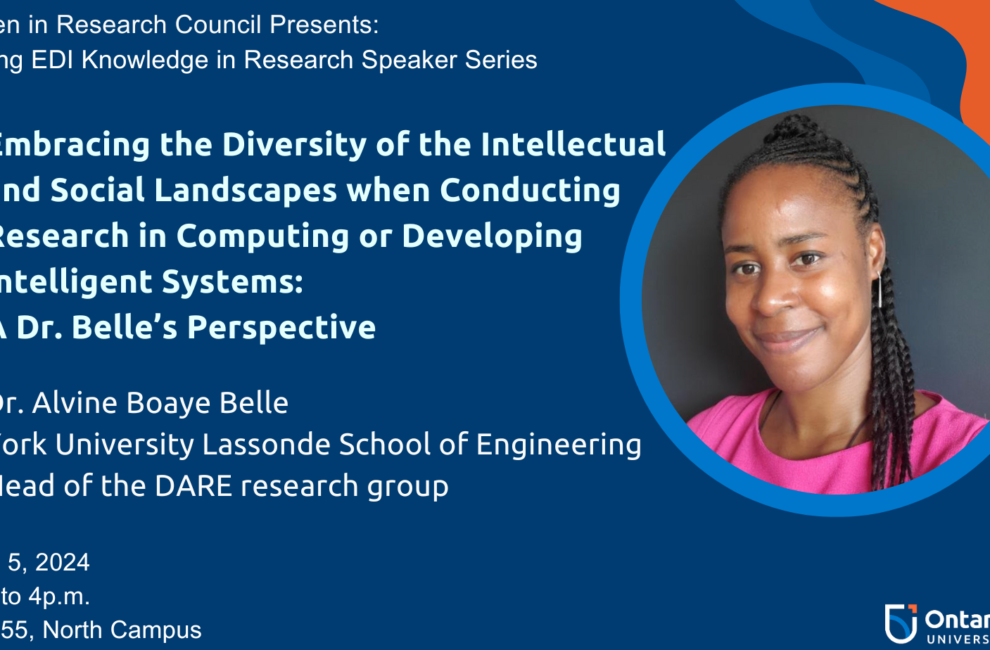
    Ontario Tech University: Embracing the Diversity of the Intellectual and Social Landscapes when Conducting Research in Computing or Developing Intelligent Systems

    Alvine Boaye Belle presents at UB 1055, North Campus, OntarioTech University. Talk description: Digital discrimination occurs when intelligent systems make automated decisions based on specific individual attributes (e.g., income, education, gender, and ethnicity) or when relying on biased data engineering practices. This may reinforce social inequities by supporting the automation of consequential and sometimes unfair […]

    Learn More

    Mining Ourselves: Collaborative Autoethnography (CAE) as Methodology

    Daniel Hocutt, Ann Hill Duin, Jessica Lynn Campbell, and Mollie Stambler present. Autoethnography is a research method that draws from a variety of autobiographical data–such as memories, documents, ongoing self-reflections and observations–to explore and investigate social phenomena (Chang, 2016). Collaborative autoethnography (CAE) has multiple researchers use a multilayered approach to collecting data, performing ongoing self-reflection, […]

    Learn More

    Infrastructures of Manipulation

    Panel Discussion: Andrew Iliadis, Francesca Tripodi, Aashka Dave, Leslie Kay Jones, Amelia Acker, Heather Ford This panel presents research on web and information infrastructures used for manipulative purposes. In contrast to platform manipulation (Woolley & Howard, 2018; Benkler et al., 2018), where users such as bad actors seek to gamify and exploit the weaknesses of […]

    Learn More

    AI empathy and the rhetoric of emergent AI teachers

    The launch of OpenAI’s ChatGPT was a popular event making generative artificial intelligence a mainstream phenomenon. Data journalist, Katharina Buchholz explains that “ChatGPT gained one million users just five days after launching in November” of 2022 (Statista, 2023). Generative AI can produce stylistically correct sentences, paragraphs, and documents across a multitude of genres (Duin and […]

    Learn More

    Social Robots and Older People’s Conceptions of Agency and Autonomy in the Socio-technical Context of Current and Future Digital Consumer Technologies

    Andrea Slane and Isabel Pedersen present Social Robots and Older People’s Conceptions of Agency and Autonomy in the Socio-technical Context of Current and Future Digital Consumer Technologies at the 2023 Annual Meeting of the Socio-gerontechnology Network. Click here for the program.

    Learn More

    Music Industry Panel Discussion

    The music industry has seen countless advancements, especially within the last few decades. From the way music is produced and performed to cutting-edge technology, new business practices and accessibility, innovation […]

    Learn More

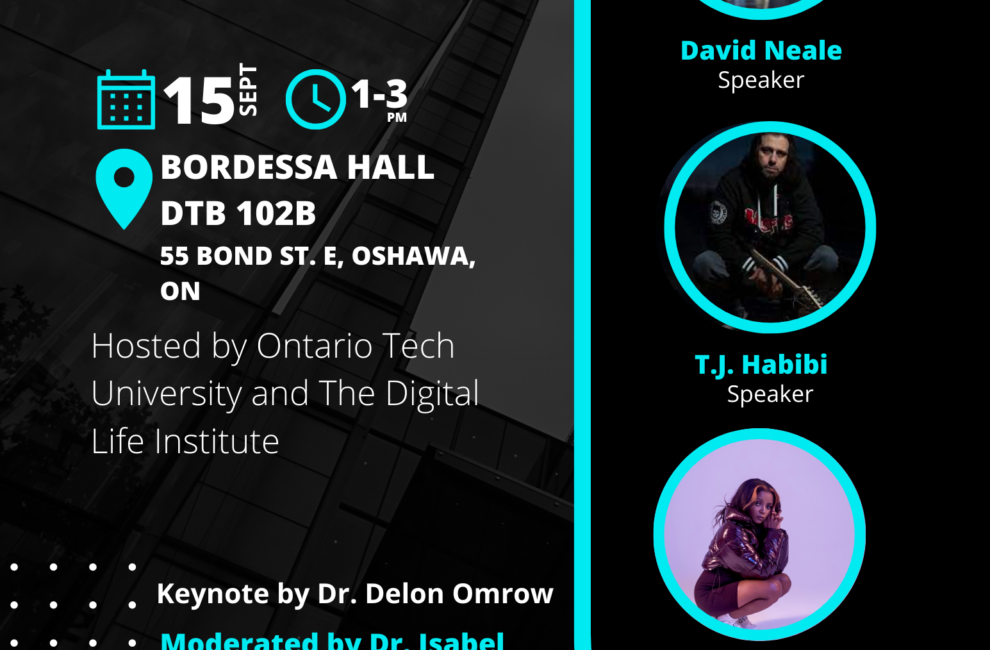
    AI Killed the Radio Star

    Join us at the Decimal Lab on Sept 15th 2023, 1-3pm for a keynote and panel on the exciting and transformative synergy between Artificial Intelligence (AI) and the music industry. […]

    Learn More

    “Ware” and Tear, Centre for Culture and Technology

    Our Second Foundation working group presents "Ware" and Tear: Extensions/Extractions of The Mediated Self Ganaele Langlois (York University) and Isabel Pedersen (Ontario Tech University) join the Second Foundation working group […]

    Learn More
    Free

    Tech with a Green Governance Conscience

    Join Ontario Tech University researchers from the Faculty of Social Science and Humanities (FSSH) and the Digital Life Institute’s Sustainability, Equity, and Digital Culture research cluster on January 26 for […]

    Learn More

    Investigating augmentation technologies: Smart education, data analytics, and human-autonomy teaming for TPC programs

    Augmentation technologies and the algorithms built within them represent the engine that drives the next generation of TPC networked learning. As emerging augmentation technologies, use of data analytics, and “smart” technologies proliferate, we see the critical need for research, presentation and discussion of the implications of augmentation technologies in TPC programs. This panel addresses critical conference themes: administering technologies in TPC programs and curriculum development.

    Augmentation technologies include wearable devices that extend human senses, augment creative abilities, or overcome physical limitations; robots marketed to improve human social interaction; implantables that amplify intelligence or memory; programs or algorithms for affective computing; Internet of Bodies (IoB) and Internet of Things (IoT) for ambient interaction or surveillance with places/spaces; and Extended Reality technologies (XR), including Augmented Reality (AR) and Virtual Reality (VR), that alter human interaction with people’s lived reality. As networked learning evolves amid these current and emerging technologies, TPC scholars must increase understanding of both the technologies and their socio-technical complexities.

    Learn More