


Cluster:
Building Digital Literacy, Other
Citation:
Shalamova N., Verhulsdonck G. (2026, June 10). Designing Conversational Interfaces to Talk Like Humans: A Framework for AI Literacy in Practice. Digital Life Institute. https://www.digitallife.org/designing-conversational-interfaces-to-talk-like-humans-a-framework-for-ai-literacy-in-practice/
 Copy to Clipboard
Increasingly, our everyday lives are mediated by digital systems that act on our behalf and help us get things done. We ask Alexa or Google Assistant about the weather and traffic updates, send messages through voice commands using Siri, and control lights or locks remotely without touching a switch. We chat with virtual assistants and AI on our mobile devices, often on the go, to set a calendar reminder, order food, and follow GPS directions that tell us where to go next. In other words, we talk to our devices, and our devices talk back to us.
Talking with conversational agents is no longer a novelty. It is an ordinary part of our digital life – how we work, learn, move through, and get things done in the world (see figure 1). In the last four years, Generative AI (GenAI) systems powered by Large Language Models have dramatically and irrevocably altered our “conversation with things” (Deibel & Evanhoe, 2021). Coupled with developments in natural language process (NLP) and machine learning (ML) algorithms, GenAI systems have given unprecedented access to tools that can write, design, and talk to us within seconds, but they have also raised renewed concerns about privacy, transparency, and the power of technology to insert and sustain its digital influence in our everyday life.
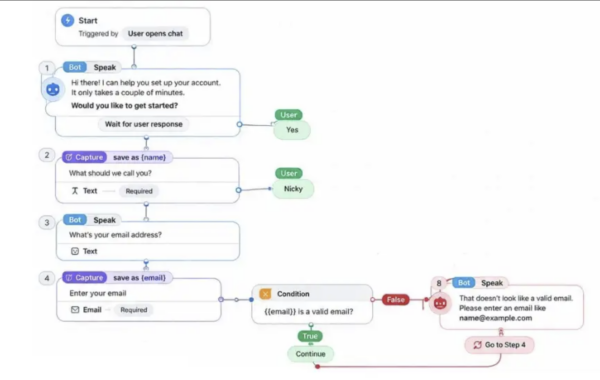
Figure 1: A visual conversation design flow of an account setup with an email requirement demonstrates the user-centered writing and AI skills needed for this field.
Recent Building Digital Literacy posts remind us that digital literacy is not just “knowing the tools.” It blends technical know-how, communication, ethics, and social awareness. AI literacy adds one more layer. Students should understand how AI works, where it breaks, how to use it responsibly, and how to verify generated outputs. They need AI literacies that help them design human friendly interactions, not simply faster outputs. Integrating AI into everyday life is not just about technologies or computer code or the latest AI model. It is also about designing for fundamental human expectations by using what conversation designer Erika Hall (2018) calls “the oldest interface” on earth – the art of human-to-human conversation. And there are rules and scripts for human conversation that can help develop better digital systems. This raises an important question: Where should students whose majors are not Computer Science or Engineering go to acquire this kind of AI literacy?
Designing Human-sounding Conversational AI: Introducing Conversation Design (CxD)
In our recent article in Communication Design Quarterly “Conversation Design: The Evolving Paradigm in Technical and Professional Communication”, we argue that conversation design is a practical and concrete way to teach students AI literacy by focusing on scripted bot conversations to help human users. Conversation Design (or CxD) is the craft of creating interactive experiences such as chatbots, help agents, voice assistants, and conversational agents talk with humans in a back-and-forth manner through turn-taking while exchanging information. Rather than focusing on conversation design as a niche area of AI research, it is a vital domain intersecting with technologies and businesses looking to capitalize on “technologies that talk”. According to Halcyon Lawrence (2023) the market for speech technologies and digital conversations is growing globally, projected to reach $33.77 billion by this year. Rather than focus on complex model architecture, conversation design emphasizes rhetorical know-how and natural interaction flow. It asks a simple yet powerful question: If an AI system is going to talk to people, how should it talk and what should be allowed to say and do?
We know from speech communication that people expect conversations to follow the principles of human-to-human turn-taking. In a conversation, people expect to be given appropriate, relevant quality and quantity of information, clarity and accuracy; and for this to be communicated in a respectful manner. In turn, people also expect their partner to listen, respond meaningfully, and adjust their message as the conversation moves along (Grice, 1975). The same principles hold in our conversational agents: in order to be meaningful, the agent has to converse with us in a pleasant manner; offer precise information while making us feel heard and understood and also be capable of dynamically addressing our specific intent and context.
For this reason, in order to be embraced by us, many conversational agents are designed to behave in a human, social manner that is familiar to us, the so-called “computers as social actors” paradigm (Nass et al. 1994). In other words, when an AI agent sounds polite and respectful, remembers what we just said, and responds in a human, natural manner, we in turn embrace it more since it comes across as a human and not simply a tool. Simply put, if conversational agents can mimic everyday principles of human-to-human conversation, we relate to them more deeply.
For us, as educators, this social dimension is interesting and an opportunity to teach students critical AI literacy. Designing for human-sounding conversation provides students with a great opportunity to make their thinking about AI visible. Students must decide what a system should do but also its limits, how it should recover from an error or misunderstanding, what it practically should say, and how it handles sensitive or private information. As part of conversation they must also imagine not just one good or perfect conversation but a chain of interactive turns where users may be vague, confused, frustrated, or make mistakes but the AI system can never be.
What Skills Does a Conversation Designer Need?
The rise of GenAI makes conversation design work even more urgent. Tools such as ChatGPT, Gemini, or Claude make it easy to generate a natural and convincing conversational text in seconds. This speed can create the illusion that there is nothing more to do than just “prompt and deploy.” Conversation design slows naive implementation of AI bots down and asks students to step back. Before they generate anything, they need to define who the system is for, what it is allowed to do (and not do), what risks are in play, and what will count as “good enough” responses.
In our article, we develop this argument further by approaching conversation design as a multidisciplinary endeavor that works well for students interested in audience-centered writing. We outline how conversation design connects to digital and AI literacy, draws on research in rhetoric, technical communication, and human-computer interaction (HCI). We also explain why human-sounding dialogue matters, and provide examples of specific classroom practices that help students design and evaluate conversational agents. Along the way, we highlight the skills that conversation designers need to do this type of work well. These skills include strong rhetorical and writing skills for shaping the conversational tone and recognizing common needs of the target audience, but also interaction design skills for planning multi-turn conversation flows, inclusive design skills for considering edge cases, ethical awareness for setting guardrails around privacy and bias, and enough technical fluency to work with AI tools and no code platforms. Furthermore, we discuss how conversation design can be integrated into existing technical communication, writing, and UX courses without requiring entirely new programs or advanced technical skills.
Conclusion: Looking to the Future
As the digital dimension of lives continues to evolve, our “conversation with things” will only become more common and more complex. The question is not whether students will interact with AI systems, but whether they will be prepared to shape how those systems interact with us. As we argue, conversation design offers one concrete way to develop critical awareness of AI systems. As we hope to have introduced in this blog post, as our digital life increasingly now also centers around conversations with agents who provide us information (and sometimes even do tasks for us), it is crucial for students to develop skills as conversation designers to provide the human interface to AI..
For technical and professional communication (TPC) as a field, conversation design is a workable path to AI literacy. That is, those in TPC are very comfortable writing user-centered, accurate and clear instructions, and are thus ideally positioned to contribute in this emerging area. It keeps TPC strengths of audience consideration, clarity, and ethics front and center, while adding interactive writing, AI platforms/tools, and structuring and grounding AI to be responsive to human contexts and specific needs. Framed this way, students can practice responsible design with AI: anticipate harm, check claims, and show their work. That is building a digital literacy you can see, teach, and stand behind. We invite you to join us in rethinking how we teach AI to talk to humans, and humans how to design with AI.
References
Deibel, D., & Evanhoe, R. (2021). Conversations with things: UX design for chat and voice. Rosenfeld Media.
Grice, H.P. (1975). Logic and Conversation. In Syntax and Semantics, Vol. 3: Speech Acts, edited by Peter Cole and Jerry L. Morgan, 41-58. New York: Academic Press.
Hall, E. (2018). Conversational design. A Book Apart.
Lawrence, H. (2024). Technical and professional communicators as advocates of linguistic justice in the design of speech technologies. Technical Communication and Social Justice, 2(1), 1–22.
Nass, C., Steuer, J., & Tauber, E. R. (1994, April). Computers are social actors. In Proceedings of the SIGCHI conference on Human factors in computing systems (pp. 72-78).
Shalamova, N. & Verhulsdonck, G. (2026). Conversation design: The Evolving paradigm in technical and professional communication. Communication Design Quarterly 13 (4), 19-31.